How Do I Host a Champagne Tasting for 6 People at Home?
A Champagne tasting for six doesn’t need a formal dining room, a cellar, or a lineup of expensive bottles. What it does need is a little planning: choose bottles based on guests, store and chill them properly, pour modest tastes, and open each bottle safely and quietly. Done well, the evening feels generous and relaxed rather than like a lesson with homework.
For six people, three bottles usually make a comfortable tasting flight, with roughly two tasting pours per person from each bottle. You can adjust the number of bottles to your budget and appetite, but the principle is simple: plan pours two-thirds of a standard glass, not a full glass. That leaves room to swirl, compare aromas, and enjoy food without rushing.
Start with the Occasion and Your Guests
Before you shop, think about who is coming and what kind of evening you want. A birthday toast, a first-time tasting, and a dinner-party pairing each call for a different mix of bottles. The best selection isn’t necessarily the rarest or most expensive; it’s the one that gives your guests something enjoyable to compare.
Choose a useful three-bottle lineup
A simple flight might include a fresh, approachable non-vintage Brut, a richer or more distinctive style, and a bottle with a clear contrast in sweetness or grape blend. For example, compare a classic Brut with a rosé and a Blanc de Blancs, or set a Brut alongside an Extra Brut and a Demi-Sec. The aim is contrast—not a test of whether guests can identify technical details.
- For a celebratory crowd: Lead with a familiar Brut and add one bottle with a festive point of difference, such as rosé.
- For curious wine drinkers: Choose contrasting styles, such as a Chardonnay-led Blanc de Blancs and a fuller-bodied blend.
- For guests who prefer softer, fruitier wines: Include a rosé or a slightly sweeter style rather than assuming everyone wants the driest option.
- For a relaxed dinner: Pick bottles that work with the food you plan to serve, not just wines that are interesting on their own.
When you choose bottles based on guests, ask yourself what they actually enjoy: crisp or rounded, dry or fruit-forward, familiar or adventurous. A bottle from Laurent-Perrier could be part of a lineup, for instance, but the label alone shouldn’t dictate the tasting. Consider the style, the occasion, and how it fits alongside the other wines.
How Much Champagne to Buy
A standard 750 ml bottle yields about six tasting pours of roughly 125 ml, though smaller tasting pours are often more practical when you’re comparing several wines. For six guests, three bottles provide plenty for a guided flight, especially if you’re serving food and water. If your group is likely to want a full glass after the tasting, plan for an additional bottle rather than making the tasting pours too generous.
For the tasting itself, plan pours two-thirds of a typical Champagne flute or wine glass. That gives each person enough to assess the wine while leaving space for the aromas to collect. If you’re serving three wines, pour one at a time so guests can focus on each bottle and you can keep the wines at the right temperature.
Bottle count Best for Serving note Two bottles A short, casual comparison Pour modest tastes and offer one wine again with food. Three bottles A focused tasting flight for six Serve one bottle at a time, with water and small bites. Four bottles A longer evening or guests who want more after the flight Keep the last bottle chilled until the group is ready for it.A note on price: No prices were provided in the scraped content, so this guide doesn’t quote bottle costs or suggest a specific budget. Prices vary by retailer, region, and release. Compare current local listings and choose a spending limit before you shop.
Store the Bottles Correctly Before the Tasting
If you’re buying Champagne ahead of time, keep the bottles somewhere cool, dark, and stable. Avoid a sunny counter, a warm kitchen, or a spot next to an oven or radiator. Sudden temperature changes and bright light are unhelpful; a quiet, consistently cool place is better.
For a short period before the event, the Visit this link refrigerator is a practical place to chill bottles. Lay them on a shelf where they won’t be knocked around, and don’t store them in the refrigerator door if frequent opening will jostle them. For longer storage, avoid treating a household refrigerator as a cellar: it is often too cold and dry for extended aging, and its temperature can fluctuate.
Keep Serving Temp at 8 to 10 C
Temperature has a real effect on the tasting. Too warm, and the wine can seem loose, with the alcohol and bubbles more prominent. Too cold, and the aromas may feel muted. For a home tasting, keep serving temp 8 to 10 c. This is a useful target for many non-vintage Champagnes and lets the wine show its character without losing its freshness.
Chill the bottles in the refrigerator in advance, then check the temperature with a clean wine thermometer if you have one. If you don’t, allow enough time for thorough chilling and use an ice bucket to maintain the temperature once a bottle is open. Fill the bucket with a mixture of ice and water; water brings the bottle into contact with the cold more evenly than ice alone. Keep a towel nearby to catch drips.
https://bizzmarkblog.com/what-is-the-safest-way-to-angle-a-champagne-bottle-when-opening/Make temperature easy to manage
- Chill all bottles before guests arrive, rather than trying to cool warm Champagne at the last minute.
- Bring out one bottle at a time and keep the others in the refrigerator or ice bucket.
- Return an open bottle to the ice bucket between pours, especially in a warm room.
- Don’t leave the bottle sitting in a bucket of ice water for the entire evening if it is already at the ideal serving temperature.
Set the Table Without Overcomplicating It
Use clean glasses that are free of detergent residue and water spots. Tulip-shaped wine glasses are particularly useful because they offer room to assess aromas while preserving the bubbles. Flutes can look elegant, but their narrow shape makes it harder to explore the wine’s aroma. If flutes are what you have, they’ll still work—just don’t fill them to the rim.
Set out a glass of water for each guest and a small plate for bites. Plain crackers or mild bread can reset the palate, while simple pairings such as salted almonds, potato chips, or a restrained selection of soft cheese are easy to manage. Avoid a table crowded with strong sauces, spicy snacks, or heavily scented flowers. Those details can compete with the wines.
Open Champagne Safely—and Quietly
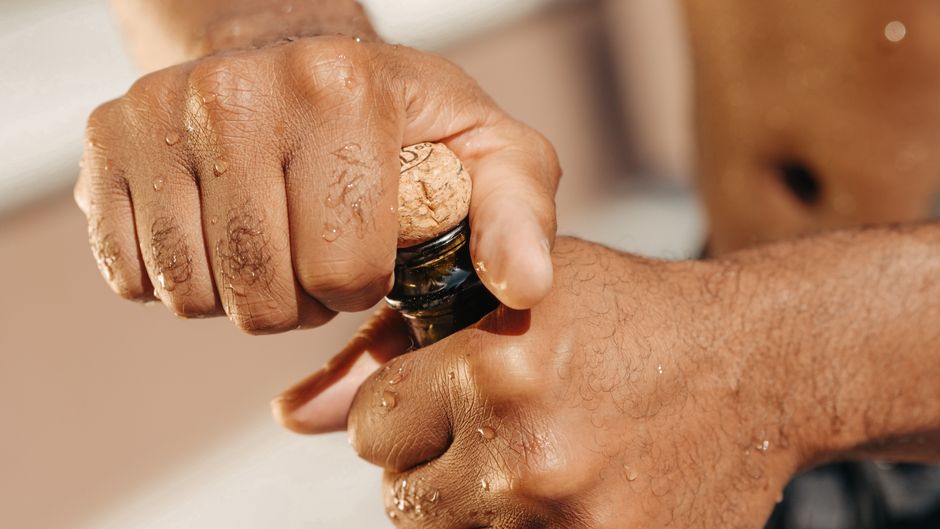
A loud pop is dramatic, but it wastes pressure and can send a cork flying. For a tasting at home, a soft sigh is better: it’s safer, more controlled, and less likely to startle anyone or spill wine.
- Start with a chilled bottle. Cold Champagne is easier to control than warm Champagne, which is more likely to foam or eject its cork.
- Keep the bottle pointed away from people and breakable objects. Never aim the cork toward a guest, a light fixture, or a window.
- Remove the foil and keep a hand over the cork. Don’t let go of the cork while the wire cage is being loosened.
- Loosen the wire cage carefully. Hold the cork securely as you turn the wire loop. Many hosts leave the loosened cage in place as an extra grip.
- Angle the bottle slightly. Hold it at roughly 45 degrees, keeping the neck pointed safely away from everyone.
- Turn the bottle, not the cork. Grip the cork firmly and rotate the bottle slowly. Let the cork ease out under your control.
- Listen for a gentle sigh. If the cork resists, keep turning the bottle slowly. Don’t force it upward or pull it toward your face.
Keep a dry towel nearby, but don’t wrap it so tightly that you lose control of the cork. Once open, pour a small taste first and let the bubbles settle before continuing. A proper Champagne stopper can help preserve an unfinished bottle; don’t rely on a spoon in the neck.
Lead the Tasting Without Turning It into a Lecture
Let guests taste before you explain the wines. Offer a few prompts and give everyone room to decide what they like. You might ask: Which wine smells the freshest? Which feels rounder? Do you notice citrus, orchard fruit, toast, or something floral? There are no required answers. The point is to pay attention and compare impressions.
Serve the wines in a consistent order, usually from lighter and drier to fuller or sweeter. If you’re comparing several bottles, pour a small taste of each before returning to favorites. Encourage guests to take a sip of water between wines, and provide a plain bite if the palate needs a reset. Keep the conversation about preference as welcome as the conversation about tasting notes.
Use Social Media for Planning, Not Pressure
Pinterest can be useful for collecting simple serving ideas, table settings, or a printable tasting card. Facebook event details or a group message can help you share the start time, ask about dietary restrictions, and let guests know the evening will include a guided tasting. Neither platform needs to dictate the style of the party. A handwritten card with the bottle names and pour order is often enough.

A Simple Hosting Timeline
- The day before: Check your glasses, choose small bites, and place bottles in a cool, stable spot if they need short-term chilling.
- Three to four hours before: Put the bottles in the refrigerator if they are not already chilled, allowing enough time for them to cool evenly.
- Thirty minutes before guests arrive: Set out water, plates, napkins, and tasting notes. Prepare an ice bucket with ice and water.
- When guests arrive: Welcome them with water or a modest first pour, and explain the order of the tasting.
- During the flight: Serve one bottle at a time, keep pours measured, and return bottles to the ice bucket between rounds.
- After the tasting: Offer food, revisit a favorite bottle if there’s enough, and keep any unfinished Champagne properly sealed and cold.
The Details Guests Notice Most
The memorable part of a home tasting is rarely an elaborate centerpiece. It’s a bottle that suits the people around the table, Champagne served at 8 to 10 C, a cork opened with quiet confidence, and enough room in the glass to enjoy the aromas. Choose bottles based on guests, plan pours two-thirds, and keep the evening unhurried. With those small details in place, a tasting for six can feel thoughtful and celebratory without feeling overproduced.